

Research
Futuresphere’s research is organised in six programmes. Each brings together two kinds of work that this site used to keep apart: research themes, which ask how the world works, and policy topics, which ask what government should do about it. We hold them together because policy that ignores how institutions and people actually behave seldom achieves its objectives.
How we choose what to review first
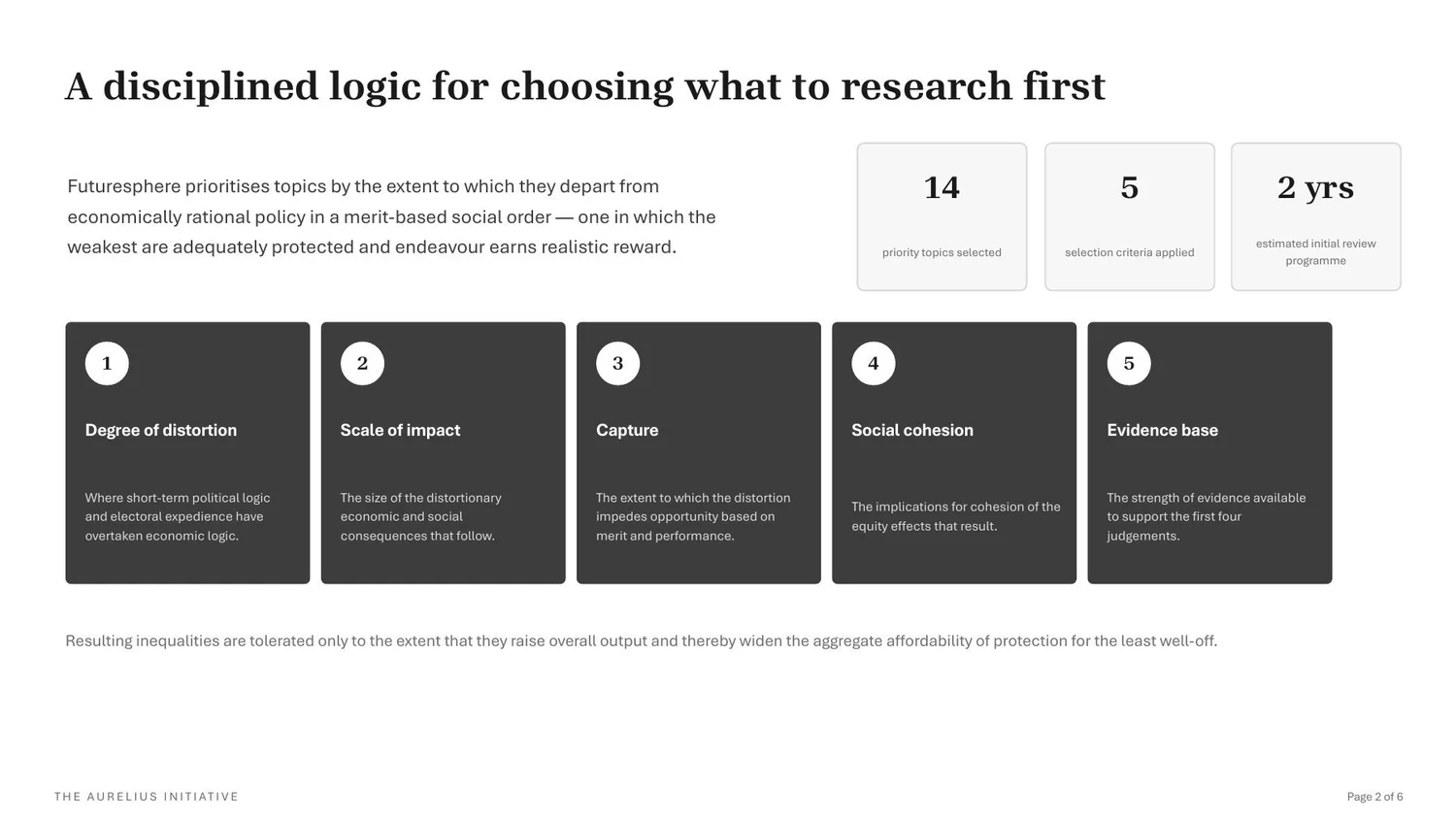
We give priority to topics by the extent to which they depart from economically rational policy in a merit-based social order: one in which the weakest are adequately protected, and endeavour and performance earn realistic reward. Five criteria govern the choice:
Degree of distortion: where short-term political logic and electoral expedience have overtaken economic logic.
Scale of impact: the size of the economic and social consequences that follow.
Capture: the extent to which the distortion impedes opportunity based on merit and performance.
Social cohesion: the implications for cohesion of the equity effects that result.
Evidence base: the strength of the evidence available to support the first four judgements.
Inequalities that result are tolerated only to the extent that they raise overall output, and so widen the means of protecting the least well-off.
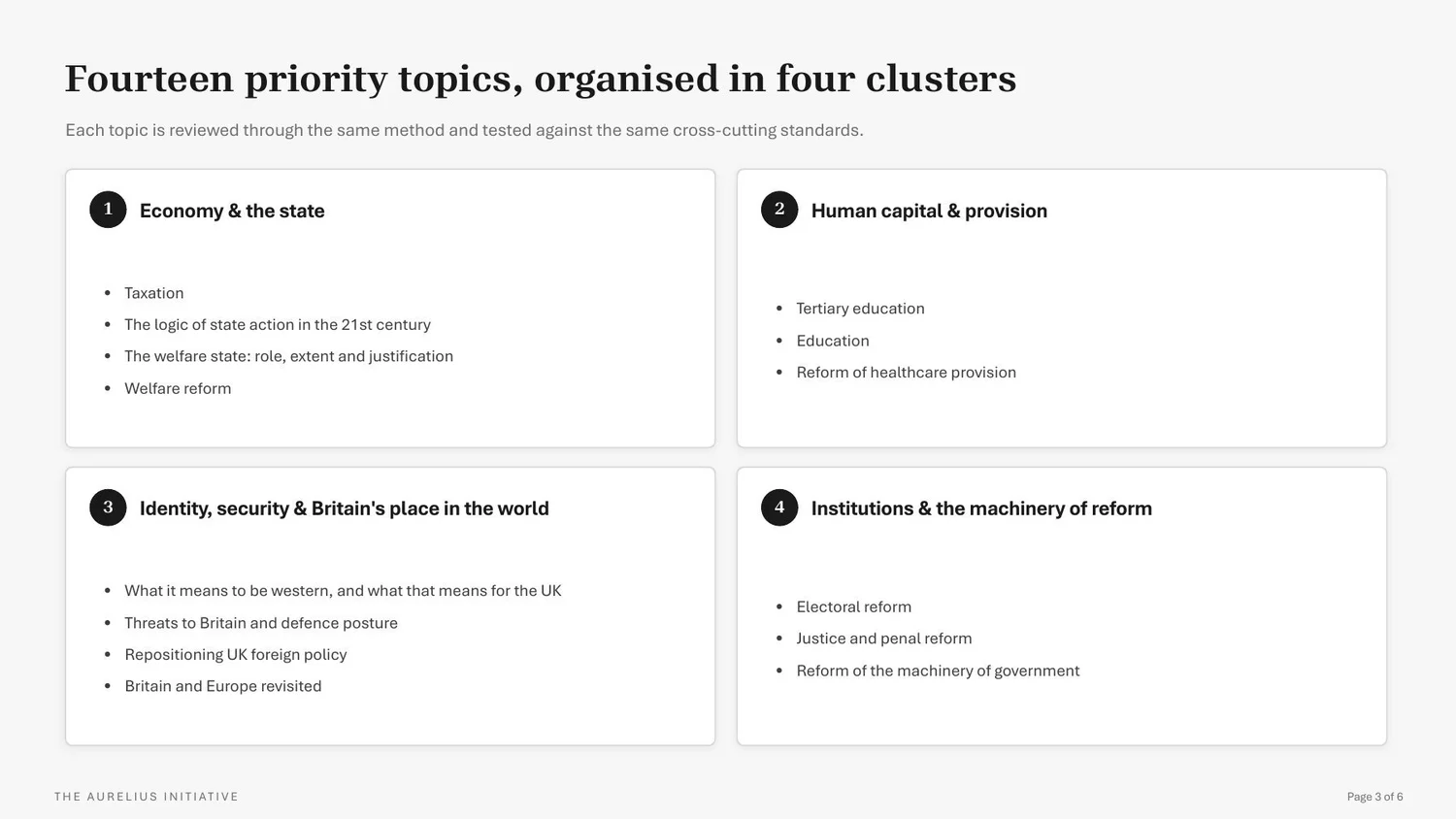
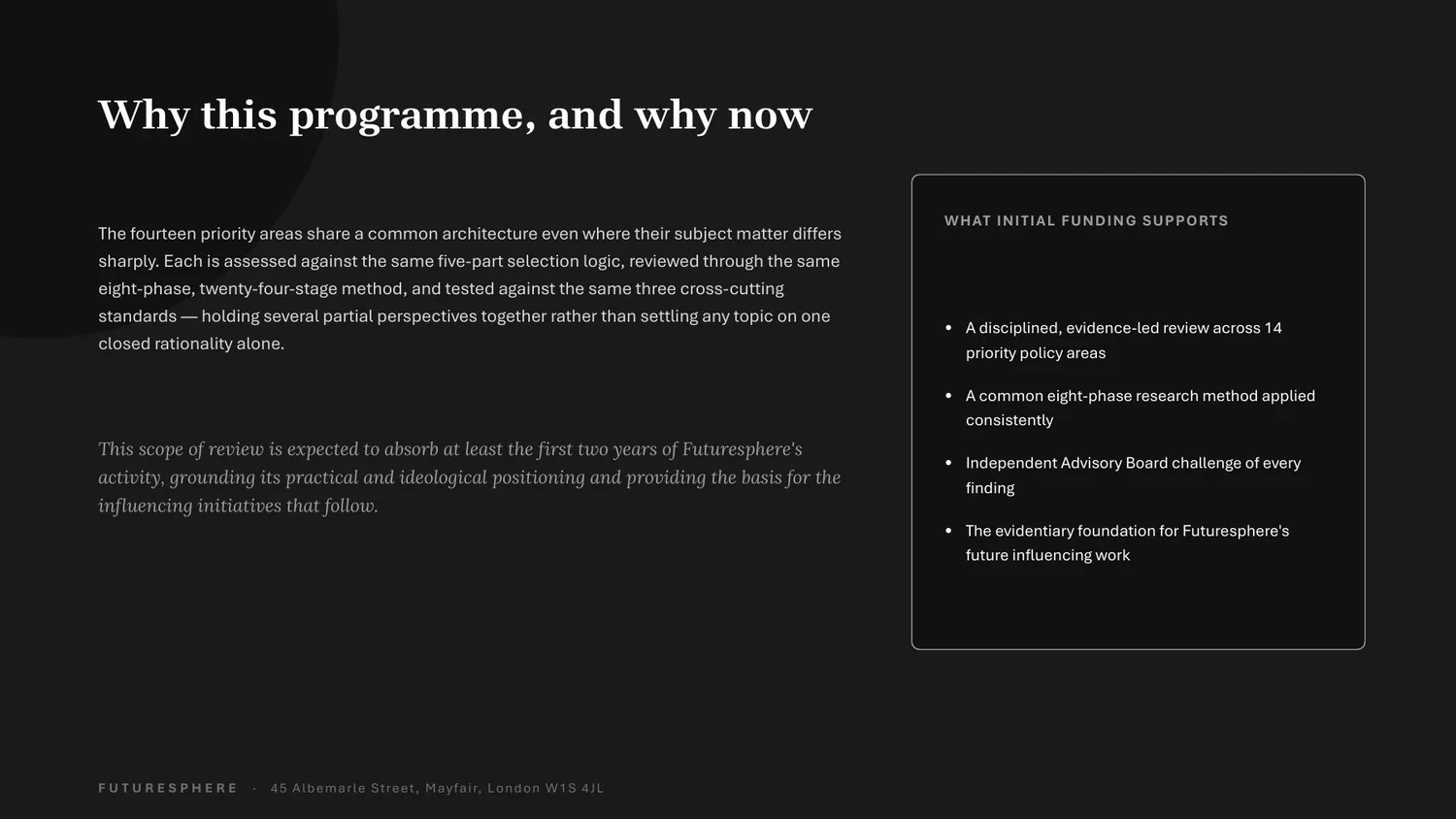
Fourteen priority reviews, in four clusters
Economy and the state: taxation; the logic of state action in the twenty-first century; the welfare state: its role, extent and justification; welfare reform.
Human capital and provision: tertiary education; education below tertiary level; reform of healthcare provision.
Identity, security and Britain’s place in the world: what it means to be western, and what that means for the UK; threats to Britain and defence posture; repositioning UK foreign policy; Britain and Europe revisited.
Institutions and the machinery of reform: electoral reform; justice and penal reform; reform of the machinery of government.
Constitutional reform was considered and deferred: the delivery risk of large-scale constitutional change in Britain currently outweighs the evidence of its benefit, so electoral reform and machinery-of-government reform, which are more nearly severable and reversible, take its place.
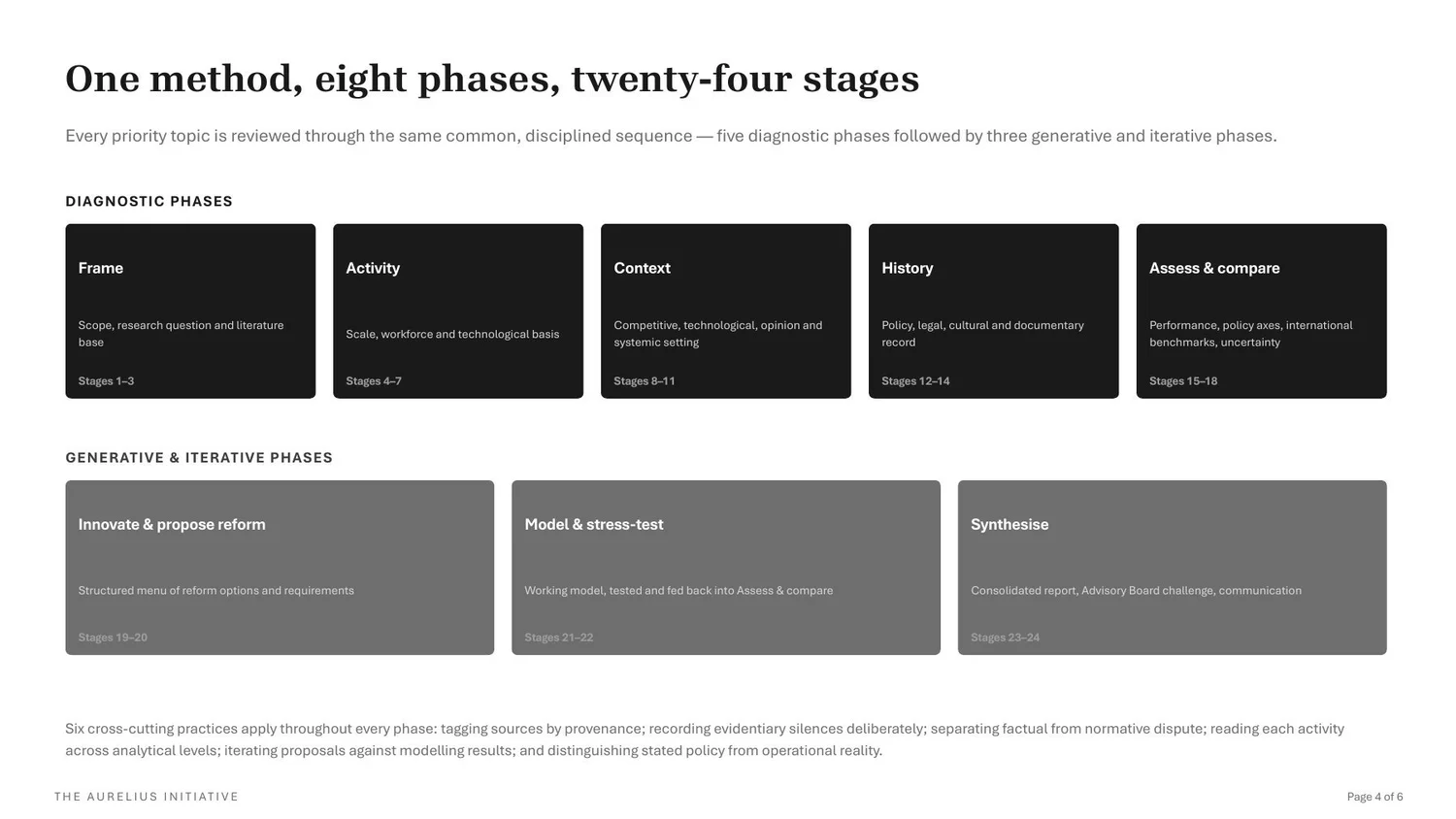
One method
Every review follows the same sequence of eight phases and twenty-four stages. Five are diagnostic (frame; activity; context; history; assess and compare); three are generative and iterative (innovate and propose reform; model and stress-test; synthesise). Six practices apply throughout: tagging sources by provenance; recording silences in the evidence deliberately; separating factual from normative dispute; reading each activity across analytical levels; iterating proposals against modelling results; and distinguishing stated policy from operational reality.
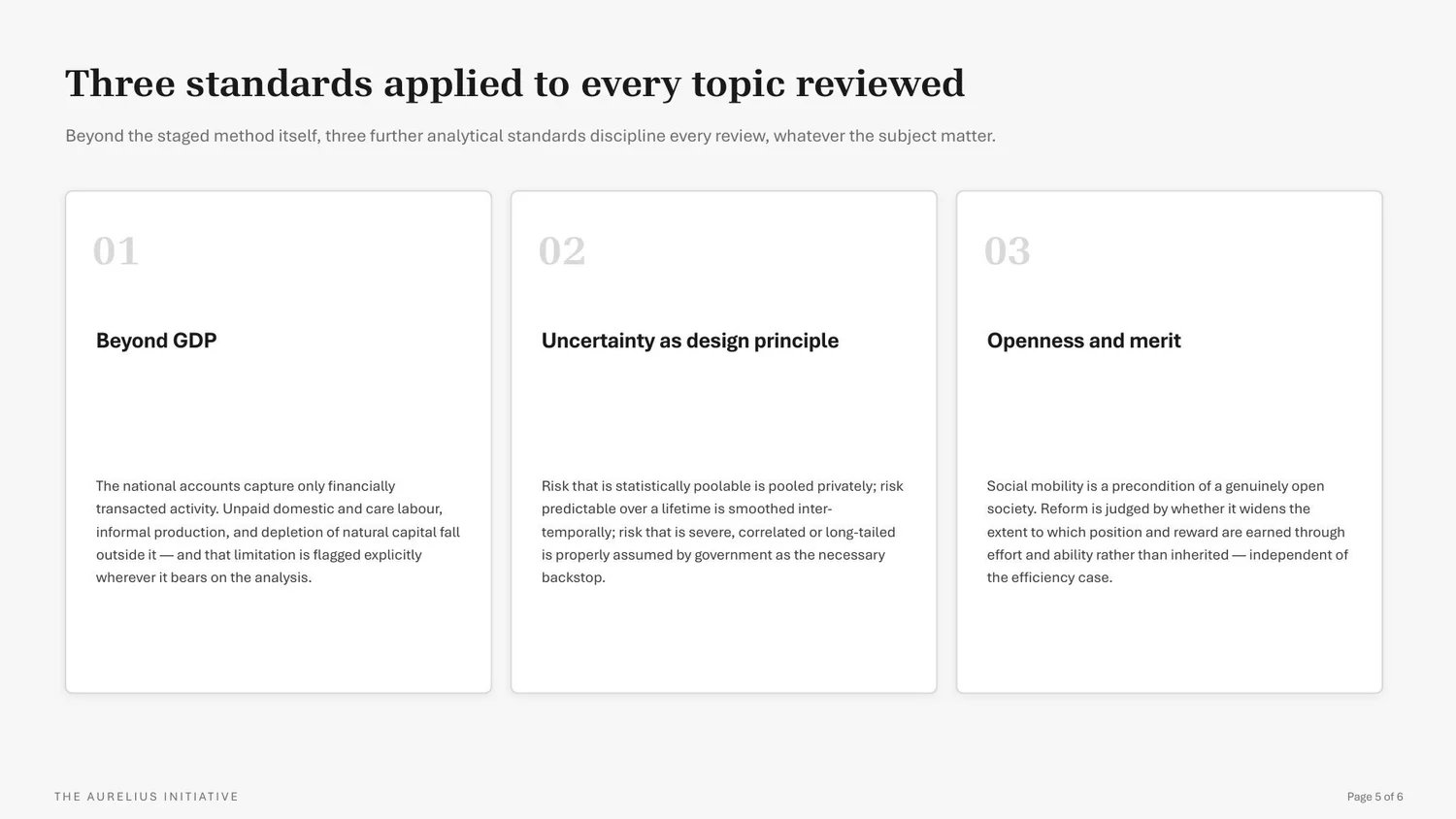
Three standards
Beyond GDP: the national accounts omit unpaid domestic and care labour, informal production and the depletion of natural capital, and we say so wherever that bears on the analysis.
Uncertainty as a design principle: risk that can be pooled statistically is best pooled privately; risk predictable over a lifetime is best smoothed over it; risk that is severe, correlated or long-tailed is properly assumed by government.
Openness and merit: reform is judged in part by whether it widens the extent to which position and reward are earned through effort and ability rather than inherited.
The fourteen reviews are expected to absorb at least our first two years. Thematic reviews are chosen separately, on similar criteria.
Our review priorities
The six programmes
 1. Renewing political economyHow politics shapes the economy, and how a renewed political economy might do better.
 2. Polycrisis and changeHow interacting crises arise and persist, and how to look ahead responsibly.
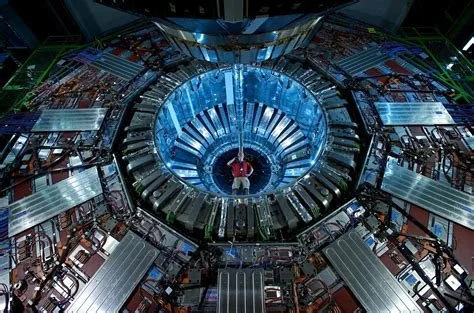 3. Science, technology and AIWho gains and who loses from new science and technology, above all artificial intelligence.
 4. Economy, markets and the environmentTaxation, competition, industry, infrastructure, energy and the natural world.
 5. Society, services and the role of the stateWelfare, education, health, justice, migration and the places we live.
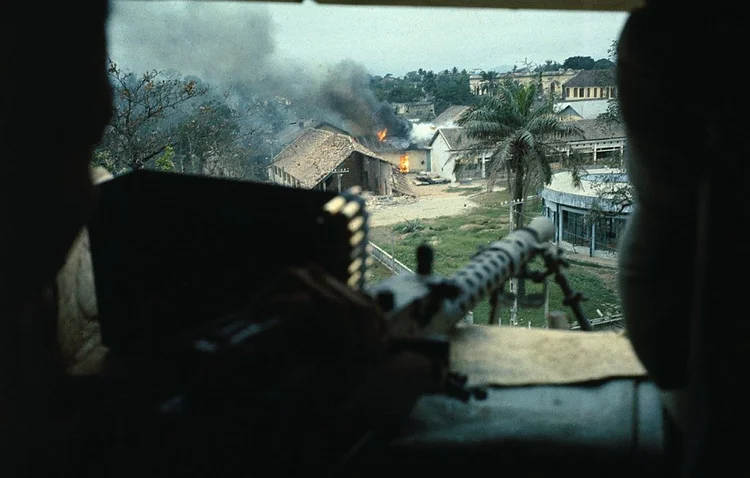 6. Governments, states and conflictsThe international system, war and peace, and Britain in the world: its interests, threats and defence.