

Our publications

Featured publication
B R I E F I N G N O T E 0 1 0 / 2 6
The Case for the Aurelius Initiative
A Consolidated Statement
The argument of the series as a whole: the problem, the principles, their application abroad and at home, and the institutions designed to carry them, set against the objectives of Futuresphere.
Our most recent publications
November 2026
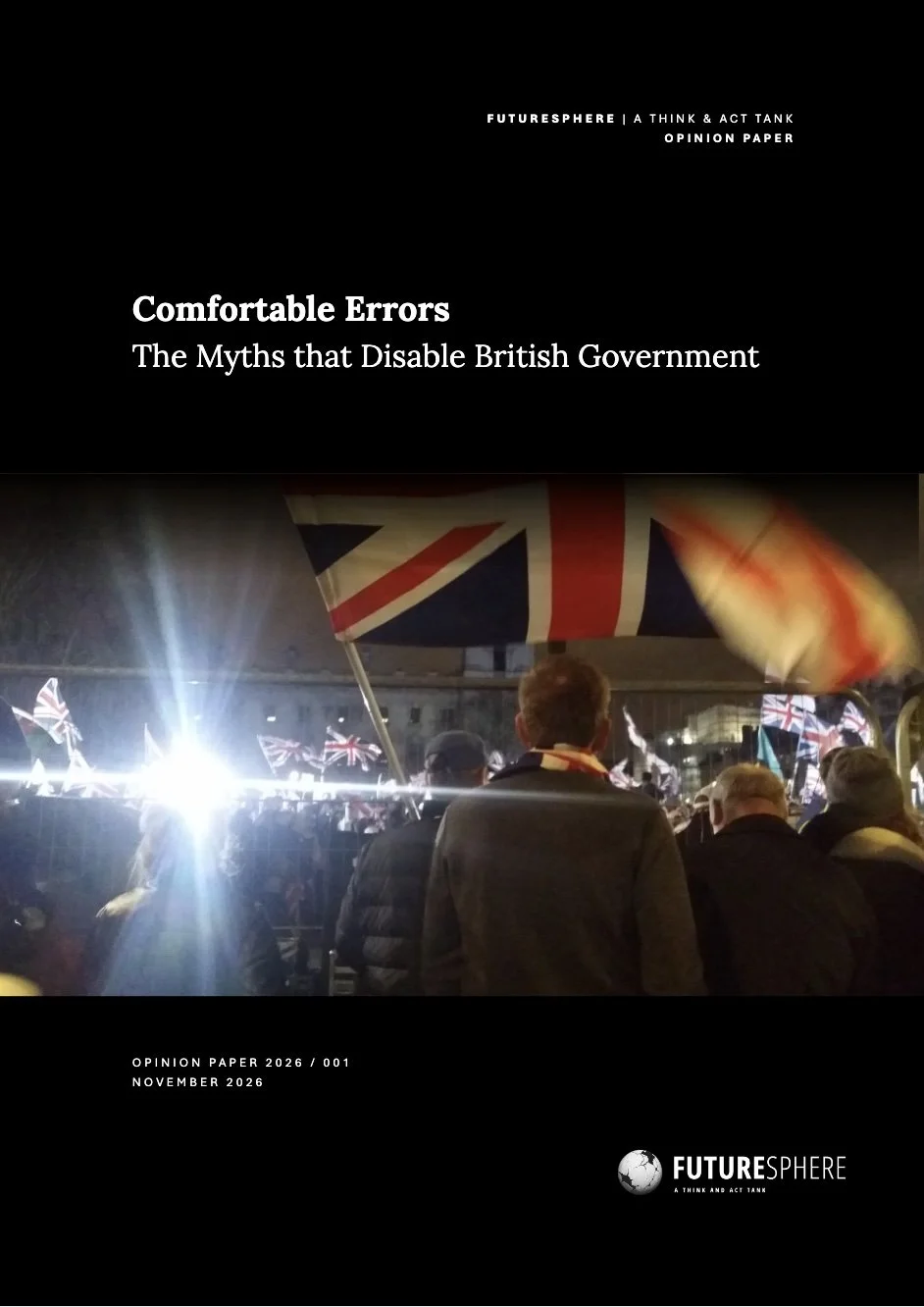
O P I N I O N P A P E R 0 0 1 / 2 6
Comfortable Errors:
The Myths that Disable British Government
A review of the prevalent myths that the British political class tells itself that distort that class’s decision-making and, thus, the country’s political economy
Briefing notes
B R I E F I N G N O T E 0 0 1 / 2 6
Polycrisis and the Failure of Political Economy
How Britain’s crises have become entangled, and why the deficiencies of current political economy are among their causes.
B R I E F I N G N O T E 0 0 2 / 2 6
Crito-Liberalism: What It Is and Why It Is Necessary
The working political philosophy of the Initiative: a liberalism of reciprocal duty and a protective state, the policies that follow from it, and why reform of the constitution needs it.
B R I E F I N G N O T E 0 0 3 / 2 6
Britain’s Future Role in the World: Acting responsibly in the impending Age of Atonement
Britain’s role in a world in transition: acting on its values rather than an image, independent of a troubled United States, central to the defence of Europe, and resilient at home.
B R I E F I N G N O T E 0 0 4 / 2 6
Strength and Cohesion in a Multicultural Britain
How empire and migration made Britain a multicultural nation, why a liberal Britain can be confident in it, and what cohesion requires: toleration as a duty of citizenship, the primacy of law, and a principled settlement for these islands, Northern Ireland included.
B R I E F I N G N O T E 0 0 5 / 2 6
Futuresphere: Its Focus and Method
What Futuresphere works on, the method by which every review is conducted, and where it stands among Britain’s think tanks.
B R I E F I N G N O T E 0 0 6 / 2 6
The Aurelius Initiative: Its Logic, and Why Start in Britain
Why research alone does not change outcomes, how four institutions are designed to act together, why Britain is the place to start, and how the approach can travel.
B R I E F I N G N O T E 0 0 7 / 2 6
People, Governance and Independence
Who leads the Initiative, how each institution is constituted and regulated, the rules that keep every board independent of its funders, and how the institutions are designed to outlast their founders.
A guide to our types of publications
Speaks for the institution
Briefing papers
Authority
Commentaries
Evaluation reports
institutional position statements
Futuresphere
Policy proposals
evidence & analysis
Research papers
editorial or exploratory
Discussion papers
Time and depth of preparation
Months
Hours
Futuresphere
Position papers
Speaks for the author
Opinion papers
A guide to our types of publications
-
An extended, evidence-based study of a policy problem, setting out methodology, findings and recommendations. (Covers reports and monographs.)
-
An exploratory treatment of an issue that tests ideas and invites debate without committing the institution. (Covers working and occasional papers.)
-
A statement of the institution’s settled view on an issue, with supporting argument and recommendations.
-
A detailed plan for a specific reform that can be implemented, often with costings, draft legislation and timetables. (Covers blueprints, white papers and manifestos.)
-
A concise summary of an issue and the options, written for busy decision-makers. (Covers policy briefs, explainers and primers.)
-
A signed argument giving one author’s view, which is not necessarily the institution’s position. (Covers essays and pamphlets.)
-
A short, timely response to current events, issued within hours or days. (Covers op-eds, rapid responses and blog posts.)
-
A periodic quantitative publication that tracks indicators, ranks jurisdictions or audits government performance. (Covers indices, scorecards and outlooks.)
Introductory papers series

In our first series of brief publications, we lay out our approach and why Futuresphere will be different. We are nerds. We are nerds because we need to be — because only through hard-won knowledge that is deep and perspectives that are broad can we hope to forge a new conceptual path that will allow us to unravel the Gordion knot of polycrisis. Ultimately, it will, like the original, be defeated by a sword; we’d just rather than sword were allegorical or metaphorical.
Looking forwards

Looking in to the future is fraught with problems, both methodologically and practically. Unlike Prometheus, we do not possess the gift — or the curse — of foresight; we must work it out the hard way. Prospective analysis, or prognostication, is part art and part science, part history and part stochastic analysis. Either way, it must be projective, imaginative, disciplined and contingent. Above all, it must be interpretive. The path before us is not literally a path.
More publications coming soon
Public policy

In the world those humans who came before us have created, power looms large, just as Nietzsche warned. In the West, courtesy of the genius and heuristic advances of the Enlightenment, we live, for the most part, in relatively free and open societies. But those freedoms are under continual threat from outside, but mostly from inside. Our tool of art is the policy of government. If we do not use it wisely and well, we will lose the democratic freedoms bequeathed to us by our short histories. At present, we seldom use government either wisely or well. We aim to try to change that through better-informed, better-reasoned and better-tested policy prescriptions.
Patience is a virtue . . .
. . . although it didn’t make Plato’s list (well, maybe Fortitude at a stretch). We’re just starting out but we’ll get there shortly.