
Futuresphere
An open society must be a tolerant society, but therein lies a paradox
Popper's paradox of tolerance
❝ Unlimited tolerance must lead to the disappearance of tolerance. If we extend unlimited tolerance even to those who are intolerant, if we are not prepared to defend a tolerant society against the onslaught of the intolerant, then the tolerant will be destroyed, and tolerance with them. ❞
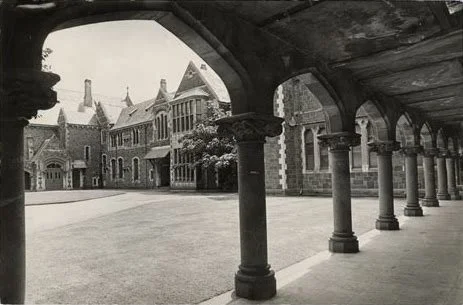
Karl R. Popper, The Open Society and Its Enemies, vol. 1, ch. 7, note 4. Popper wrote the book while lecturing at Canterbury University College, Christchurch, New Zealand (pictured), between 1937 and 1945 (Munz 1998).
A think and act tank
Yes, we know: Britain does not lack think tanks. The fourteen domestic think tanks on politics, economics and governance that file accounts with the Charity Commission spent about £47.5 million in their latest financial years (Charity Commission 2026). Many excellent ideas emerge from them. Yet failures of the kind that King and Crewe (2013) catalogued continue to recur, too many think tanks address the problem of the day without its political or economic context, and too much of their signal is lost in partisan noise.
We aim to change that.
Futuresphere is a think and act tank in London, in the liberal democratic tradition of J. S. Mill and Karl Popper. Grounded in political economy, it examines the changes that science and technology will bring, and addresses complex social problems and contested issues as wholes, from several disciplinary perspectives. It covers every area of public policy and global affairs, and argues for open, competitive markets, fair and democratic institutions, and individual rights matched by duties and responsibilities. Futuresphere Prospectuary Limited is incorporated as a company limited by guarantee, and its website already indicates the breadth of the work it intends.
The protective state
Futuresphere's research centres on uncertainty and the future: how a liberal democratic society copes with the change that science and technology will bring, socially, politically, economically and environmentally. These questions reach into the philosophy of knowledge in the social sciences, into individual and social psychology, into the economics of institutions, and into the role of the state.
On the last, Popper's protectionist theory of the state is our starting point (Popper 1945). Freedom must be secured by the state, and only a state controlled by free citizens can secure it. That leaves no room for a minimal state that offers citizens no practical protection of their rights. Nor does it leave room for a market fundamentalism that ignores predation and exploitation, which Adam Smith recognised in 1776 (Smith 1776). The hand that allows competitive markets to work for the benefit of all must be, at least in part, visible. The trade-offs are unavoidable, and they must be settled politically in the democratic public sphere, just as the limits of tolerance must be negotiated to keep a tolerant society.
Futuresphere's role in the Initiative
Futuresphere is meant to be judged by outcomes, the effects of what it does, as well as by its outputs. That is why we call it a think and act tank.
It contributes editorially to XPLN Media, coordinating the topics of its debates and briefing packages, and draws on XPLN's production capability to carry its proposals widely.
XPLN Media draws on Futuresphere's researchers as panel participants.
ProSPEc's academic staff take part in Futuresphere's research, which supplies current examples of policy development for ProSPEc's courses.
Above all, Futuresphere convenes colloquia in which invited participants spend several days debating and planning together, first at the London headquarters and in time at the rural estate. Each colloquium is to end in a plan of action, agreed between the participants and tracked by Futuresphere afterwards, so that coalitions act together on the policies they support.
Like other think tanks, it holds seminars on topical issues of policy for corporate, voluntary-sector, public-sector and individual audiences. Its income is planned to come from personal gifts, commercial and contract work, and membership.
References
Charity Commission for England and Wales (2026) Register of charities: latest filed accounts of fourteen think tanks on UK politics, economics and governance (accessed October 2026).
King, A. and Crewe, I. (2013) The Blunders of Our Governments. London: Oneworld.
Munz, P. (1998) 'Popper, Karl Raimund', Dictionary of New Zealand Biography, Te Ara. Te Ara
Popper, K. R. (1945) The Open Society and Its Enemies. London: Routledge.
Smith, A. (1776) An Inquiry into the Nature and Causes of the Wealth of Nations. London.
Previous: The Initiative's elements · Contents · Next: XPLN Media