

Theme 2
Science & scientific research, application of science as technology & society
Q. Is artifical intelligence hype or will it be transformative?
A. The answer is neither and both.
What is articifical intellidence. What is it artificial intelligence not? What better way to find out than ask an AI tool. We put these questions and other questions to Claude, the interactive AI generator developed by US firm, Anthropic.
Artificial intelligence refers to computational systems that perform tasks normally associated with human cognition: recognising patterns, making predictions, generating language, and adapting outputs based on data. At its core, modern AI is statistical inference at scale, identifying regularities in vast datasets and using them to produce probable responses. What AI is not is consciousness, understanding, or reasoning in the human sense. It has no beliefs, intentions, or genuine comprehension; it manipulates symbols and probabilities without grasping their meaning the way a person does.
Large language models (LLMs) such as the GPT and Claude families are trained to predict the next unit of text given preceding context. Their fluency can resemble thought, but they operate primarily on syntactical logic, the rules governing how symbols combine, rather than true semantic logic, the meaning behind them. An LLM produces grammatically coherent output, yet its grasp of meaning is inferred from statistical association rather than lived experience, which is why models can be eloquent and confidently wrong at once.
A central distinction separates narrow (specific) and general intelligence. Narrow AI excels at defined tasks: translation, tumour detection, recommendation, or chess. Every system in commercial use today is narrow. Artificial general intelligence (AGI), a hypothetical system reasoning flexibly across any domain at human level, does not yet exist.
AI applications group by modality. Verbal applications handle language: chatbots, translation, summarisation, transcription. Visual applications interpret or generate imagery: facial recognition, medical imaging, autonomous perception, image generation. Expressive applications create new content, often multimodally: marketing copy, music, graphics, synthetic voices.
This raises the question of originality and creativity. Strictly speaking, generative AI is recombinant rather than truly original. It produces novel arrangements by interpolating across patterns absorbed from training data, not by drawing on intention, emotion, or a desire to communicate something. In verbal applications this yields fluent prose and plausible ideas, but rarely the conceptual leap or hard-won perspective behind genuinely original writing. In visual applications, image generators conjure striking, unexpected compositions, yet these emerge from statistical blending of existing aesthetics rather than authentic artistic vision. In expressive applications, the distinction sharpens: a model can pastiche a genre convincingly while lacking the lived motivation that gives human art its meaning and stakes. The output may look creative; its novelty is combinatorial, not intentiona
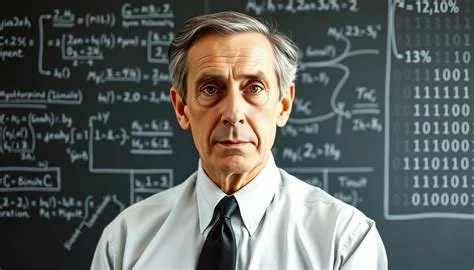
Claude Shannon (1916—2001) was an American mathematician, electrical engineer, computer scientist, cryptographer, and inventor known as the "father of information theory", and the man who laid the foundations of the Information Age.
Shannon was the first to describe the use of Boolean algebra (IF, THEN, AND, OR) —essential to all digital electronic circuits—and helped found the field of artificial intelligence.
Closely tied to this is style and tone of voice. LLMs are remarkably adept at adopting and imitating register, whether formal, playful, academic, or terse, because style is itself a statistical pattern in language. A model can shift fluidly between a legal brief and a children's story, or mimic a specified author's cadence. Yet this is surface emulation: tone is reproduced as form rather than expressing a stable personality or genuine emotional state. Skilful prompting can steer voice precisely, making LLMs powerful stylistic tools, but the consistency and authenticity of a human voice, rooted in identity and experience, remains absent.
In terms of labour displacement, the most exposed work is routine, codifiable and information-based: administrative and clerical roles, customer service, copywriting, translation, document review, and boilerplate coding. Displacement is usually partial, AI absorbing specific tasks rather than whole occupations, reshaping roles toward oversight, judgment and interpersonal skills. Work demanding physical dexterity, deep contextual judgment, emotional intelligence, accountability, or true originality stays comparatively resilient.
In sum, AI is a powerful pattern-processing technology, narrow in capability and syntactic in nature. It emulates style and recombines existing material with impressive fluency, but its creativity is derivative rather than intentional, transforming labour markets by automating predictable cognitive tasks while leaving genuinely original, embodied and relational human work largely intact.
The Enlightenment vision
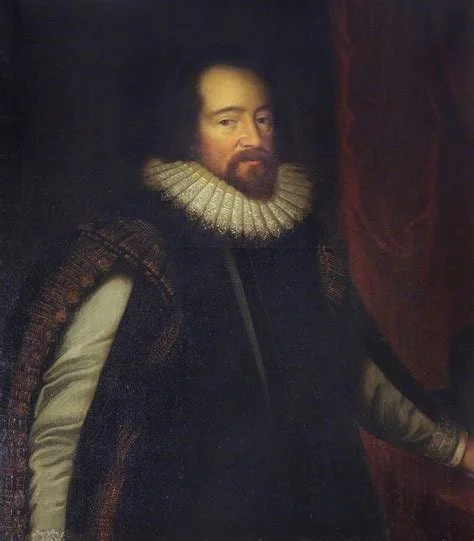
Almost all the progress we enjoy today in science and the technology to which it has been applied has emerged from the efforts of scientists since the publication of Francis Bacon’s landmark Novum Organum in 1620. Baconian experimental method is scientific method. However, the broader insights of the European Enlightenment are not as well reflected outside the physical sciences. That needs to change. And the benefits offered by the Enlightenment mission have yet fully to be realised, either in the developed ‘West’ or especially elsewhere. That, too, needs to change.
What is the role of the West in progress?
While the state of Western science in the 1500s was no further ahead than the science of other areas of civilisation, especially in the Muslim world and in China, all that changed with the increasing sophistication of observational astronomy and from 1620 with the adoption of Baconian method. Why did this development occur in Europe and why did European knowledge come so significantly to outstrip that of other civilisations. And, as that technology has diffused across the world in the modern era, what does that mean today?

What is progress?
Progress, of course, is not a single dimension, nor is it linear as is often presumed. Progress in science tends to be accretive, but that does not mean each newly accreted layer is beneficial, and certainly not uniformly beneficial to all. We need to be clear about what re understand by progress, and avoid measuring uni-dimensionally, as aggregate economic growth, for example. As Kuznets cautioned even as he developed the system of nationally accounting (SNA) for the US NBER, an exchange-based accounting of economic activity does not capture all economic activity; SNA has blindspots. What are the options?
Loss of scientific hegemony: Winning through losing?
Much is made of the previously less developed regions catching up with the West in terms of wealth and consumption opportunities. Development theories have long expounded prospective theories of convergence. Yet Western politicians insist on portraying technological development as a zero-sum game. This has rapidly become a self-fulfilling prophecy. Competition in science and technology development is healthy as long as the impacts are managed economically, politically, socially and environmentally. With one-sixth of the world’s population, you would expect China to have a material portion of the world’s ideas. Why has this competition come to be perceived so starkly as zero-sum, what does that mean and what can we do about it?
Can intelligence be artificial? What is AI
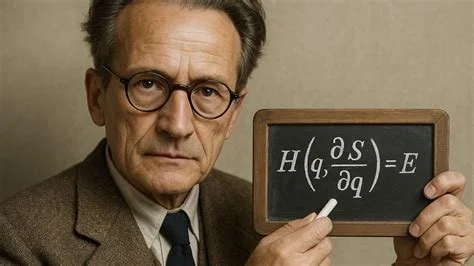
Mush of the confusion that exists around the nature and role of artificial intelligence is inherently anthropomorphic; we think of humans as uniquely intelligent, but this is not the case, as anyone who has observed closely other upper-order primates or who has spent time with a border collie will realise. We, humans, have simply developed further; our primacy socialisation is verbal, allowing for enculturation that is problematic in the absence of language.
Where human differ from other animals is in the nature of our consciousness — our principally verbalised self-awareness and out awareness of others.
Because many of the functions of animal (including human) intelligence are programmatic and this programmable, machines can process these tasks at speeds and with level of accuracy of which most humans can only dream. Without consciousness, while machine may form simulcra of the sympathy that Adam Smith (1758) identified as being at the core of our moral sentiments, what today we call empathy, machines will not be able independently to form moral judgements in the imaginable future.
Approaching synthetic general intelligence sensibly
Without sympathy as the moral sentiment at the core of human consciousness, there are limits to the pursuit of artificial general intelligence.
Yet it is that very deficit that can make machines seem most human. Machine-based intelligence is infinitely patient precisely because it is not burdened with moral sentiments; it does not become annoyed and thus does not, unless programmed to do so,become impatient. But that is not human patience; it is merely a simulcrum of human patience caused by the absence of impatience.
In much the same way, while machines may be programmed not to do harm, that harm avoidance is purely deontological — based on rules that have, in this case, been instilled in the machine at creation or upon programming; it is merely algorithmic. While machines may become considerably better at recognising and responding to human response and reaction and may even learn — acquire new situational knowledge — independently, this is not general consciousness of a form comparable to human general intelligence.
Nor is the ability to innovate a sign of general intelligence; it may be achieved by stochastic variance and recombination of variable factors with a context gate and a sense gate filtering out the unworkable. This is not innovation by imagination but iterative innovation by large numbers — a sort of speeded-up heuristic of accidental discovery. Computers are not people too.
Quantum what?
Physics has spent the last century quietly dividing in two: the classical world of Newton and Einstein, which still governs bridges, rockets and planets, and the quantum world of Bohr, Heisenberg and Schrödinger, which governs everything smaller. For decades the latter was mathematics without application - brilliant, verified, and largely academic. That is no longer true. Quantum mechanics is fast becoming the applied physics of this century, much as Newtonian mechanics was of the last three. Quantum computing exploits superposition and entanglement to solve classes of problem that are intractable for classical machines in fields as diverse as in cryptography, materials science, drug discovery and logistics optimisation; quantum sensing promises measurement of gravity, time and magnetic fields at precisions once thought impossible; quantum communication offers, in principle, unbreakable encryption. Beneath all of this, unresolved questions about dark matter, dark energy and the reconciliation of quantum theory with gravity suggest that physics itself is not finished, only paused between revolutions. Governments and corporations are now racing to command what has already been discovered, aware that whoever masters it first may render current encryption standards, and much else besides, obsolete.
As with artificial intelligence, the challenge is not merely technical. It is whether our institutions, our security architecture and our regulatory frameworks can cope with an entirely novel paradigm of how the world (and all other worlds) actually works.

Future shocked? The Toffler phenomenon
All change, including progress, comes at a price. Thinkers since antiquity have observed this, particularly astutely, in the cases of, for example, Machiavelli and J.M. Keynes. And Alvin Toffler. His 1970 work Future Shock offered both an acutely diagnostic and unusually prognostic perspective on how change impacts human society at all levels. His masterful follow-up, The Third Wave, took up the challenge of the technology revolution that, when the book was released in 1980), a mere 15 to 20 years in to its now relentless and seemingly-inexorable path on which we have now been moving for closer to 60 years, timed by the release of Gordon Moore’s famous paper in 1965.
Since the publication of Bacon’s Novum Organum in 1620, human progress has changed. What previously was dictated by sporadic innovation and gradual diffusion — essentially a punctuated equilibrium technological stasis — has, in the wake of the industrial revolution and now more than half a century in to the technology or digital revolution, transformed into continuous change, bringing with it the future shock of which Toffler wrote.
But, to return to the insights of Machiavelli and Keynes, the human ways and habits of the past are seldom surrendered willingly. We faced in 1980 and still face today what Toffler described as ‘the super-struggle for tomorrow.’ Even the half-time score is difficult to gauge. But that is why we need Futuresphere.
Scientists are people too, you know: the process of science
The different types of scientist
What is a scientist? This question can only be answered by addressing the more fundamental question: what is science?
We are used to thinking of the ever-proliferating categories of physical scientists around the interstitial spaces of the major sciences — The physical sciences of physics, chemistry, astronomy, earth sciences (geology, meteorology, oceanography) and the life sciences (biological sciences): biology, botany, zoology, ecology, genetics, microbiology.
To these, many would add the formal sciences of mathematics, logic, statistics and theoretical computer science.
These can be viewed as the basic sciences, which can then be applied to practical problems in the applied sciences — engineering, medicine, agriculture, computer science, architecture.
But after that, it gets problematic. First there are the social sciences — the studies of human nature, behaviour, relationships and society.
Then there are the composites — Information science is a good example: it draws on computer science, cognitive science, and communication theory from psycholinguistics, itself a composite field; and from information science: artificial intelligence which also spans physical and applied science.
The list proliferates, usually without answering the basic question: what is a science?
Scientific inference
Since Aristotle, inference has divided along his lines: induction (epagoge), reasoning from particulars to universals, and deduction (syllogismos), reasoning from universals back down via the syllogism — together forming what he called apodeixis, demonstration. Aristotle allowed these to work in combination from the start. Over two millennia later, Russell's 1910 essay On Induction exposed induction's inevitably-provisional justification. Meanwhile, from 1878, American C.S. Peirce formalise a third mode, which he developed progressively over his career until he settled on the term abduction, or inference to the best explanation from incomplete evidence.
Use them, misuse them and abuse them; we must do with these as we will.

Normal science and the meaning of science
Since the publication of Thomas Kuhn’s brilliant The Structure of Scientific Revolutions in 1962, there has been endless debate over the relative merits of Kuhn’s image of science as the search for the resolution of anomalies and Karl Popper’s prescription of falisification from his Logik der Forschung in 1935 (The Logic of Scientific Discovery) , which did not appear in English until 1953. Popper’s work had been widely interpreted in English since its original publication and Kuhn’s work was widely, but wholly wrongly, seen as unseating Popper’s mastery over the nature of science. Quite why these two approaches — the first normative and the second descriptive — should be regarded as in opposition is baffling.
While the debate appears as abstract as it surely is, it has material practical implications, namely about the limits of science. Often this, too, is of minimal consequence, until it hits the practical world of policy and human action. The case in point is anthropogenic climate change. And then it really starts to matter. What is a justified scientific belief? Is unanimity important? what of contrary views? If all knowledge is provisional — the ultimate logic of falsification — what can we really know? These questions are pressing and require urgent public airing.
Personalities and controversies
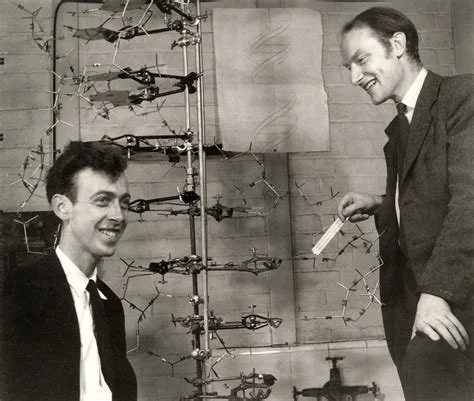
While Newton claimed that he could see a long way because he was standing on the shoulders of giants, science is a winner-takes-all business. For those that get there first come honours, recognition and immortality. This is clearly the case with the description of the double-helix xtructure of DNA, the ‘building block’ of life and the transmitter of coupled genetic code, described by James Watson & Francis Crick in 1953. There names will last in pantheon of scientifc greats.
continues below
Personalities and controversies; science is a human institution.
While Newton claimed that he could see a long way because he was standing on the shoulders of giants, science is a winner-takes-all business. For those that get there first come honours, recognition and immortality. This is clearly the case with the description of the double-helix structure of DNA, the ‘building block’ of life and the transmitter of coupled genetic code, described by James Watson & Francis Crick in 1953. There names will last in pantheon of scientifc greats. Less so, Maurice Wilkins, who was jointly awarded the Nobel Prize in Physiology or Medicine in 1962. However, the recognition these three received has not been without controversy.
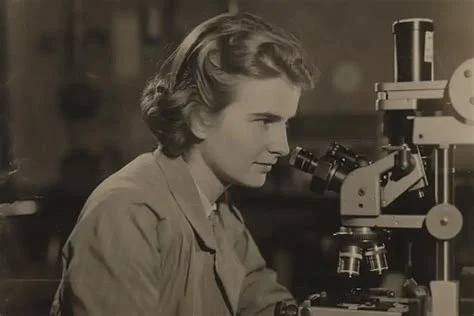
Contemporaneous to the research at Cambidge by Crick and Watson, chemist Rosalind Franklin was working in biophysics research for the Medical Research Council at KCL using X-ray diffraction crystallography the under laboratory director, renowned physicist John Randall. While Maurice Wilkins was on holiday from KCL laboratory in 1950, work that Wilkins had been undertaking in DNA structure was reassigned by Randall to Franklin along with Franklin’s research assistant Raymond Gosling and supervision of Gosling’s PhD. Unsurprisingly, the created friction between Franklin and Wilkins.
Using Franklin’s superior x-ray diffraction crystallography techniques, Franklin and Gosling made considerable but laborious progress, leading Franklin to conclude that DNA may have a helical structure. However, the evidence at that point was conflicting. In May 1952, Gosling produced the famous photo no.51.
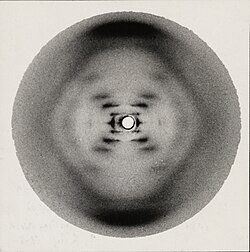
Franklin was due to leave KCL to move to UCL Birkbeck. Gosling’s research and supervision were to be transferred back to Wilkins. At Randall’s direction and at Franklin’s suggestion that he do so (according to Gosling’s subsequent account), Gosling shared his findings with Wilkins.
In turn, suspecting its signficance, Wilkins shared the work with Crick at Cambridge, hoping to complete description of the DNA structure collaboratively before Linus Pauling at CalTech, who was also working on the problem, successfully identified the correct structure. Pauling and a colleague had published a paper proposing a triple helix structure that had been shown to be inoperable.
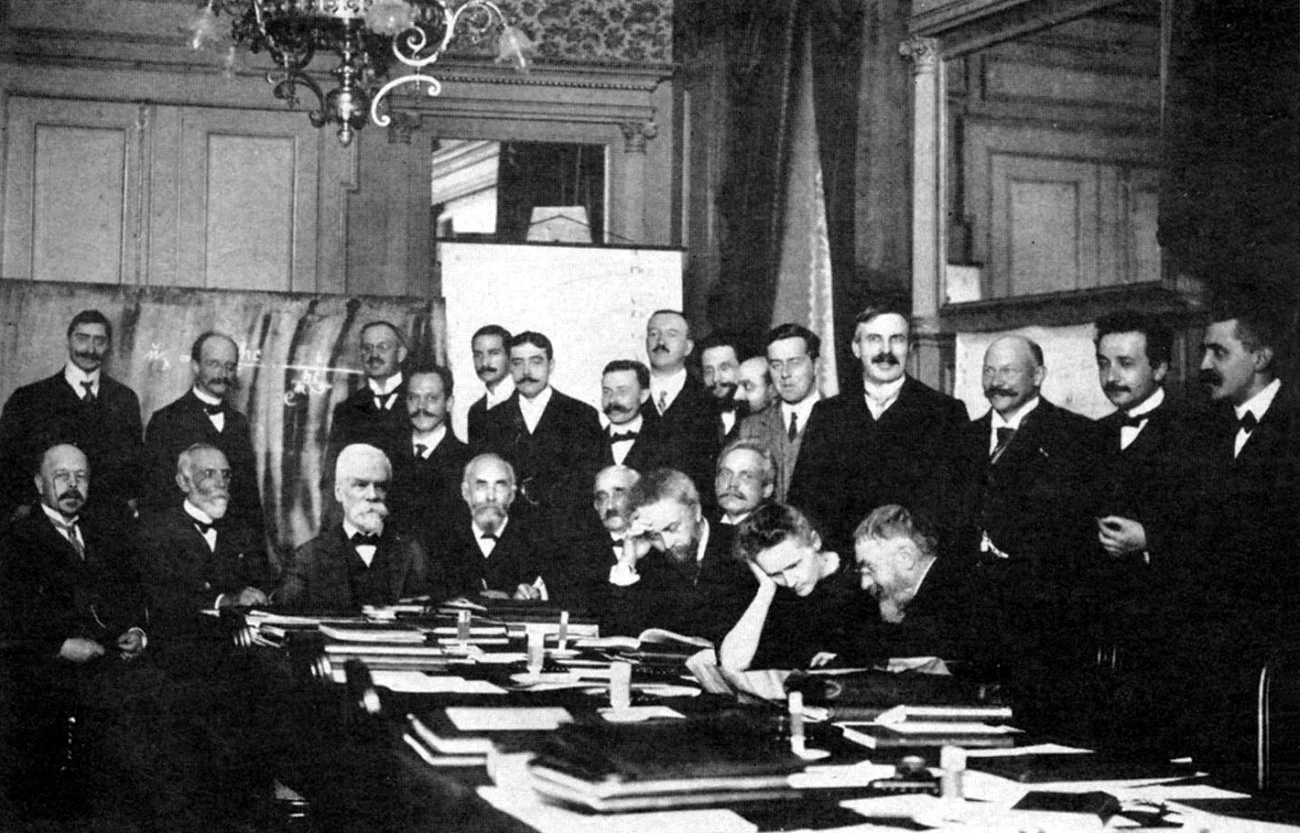
Crick immediately recognised the implications of the image based on earlier publications by his collaborator, Watson, as confirmatory evidence of their hypothesised anti-parallel double-helix structure of intertwined sugar-phosphate chains, supported by data they had previously obtained from Franklin and Gosling’s research via an MRC research report. Watson’s and Crick’s conclusions on structure were announced by their laboratory director, Sir Lawrence Bragg, at a Solvay conference in Belgium 8 April 1953 and published in Nature in publiched their findings in Nature two weeks later.
Watson’s and Crick’s modelling depended in part on Franklin’s data and was confirmed by Gosling’s image which validated their anti-parallel double-helix model. Watson later acknolwedged that he and Crick would not have identified the structure without Franklin’s (unpublished) work. Franklin had identified all the pieces but did not put them in the correct structure. It was Watson and Crick’s hypothesis of the anti-parallel structure that led to them to define the structure correctly, validated by Franklin’s earlier data.
Franklin maintained friendships with Crick and his wife, including period of convalescence at their home following operations to remove ovarian cancers. Franklin died in April 1958 from complications associated with ovarian and metastisised cancers.
In 1962, Watson, Crick and Wilkins were jointly awarded the Nobel Prize in Physiology or Medicine. Having died, Franklin was not considered for the Prize. In and interview in 2003, Watson expressed the belief that, had she still been alive, Franklin would have shared the Prize.
Following the publication in 1975 of a biography by Franklin’s friend, Anne Sayre, the role of Franklin’s contemporaneous work in crystallography at KCL contributing to the identification of the DNA structure became a rallying point for feminist and other claims of misogyny and gender-based discrimination in science. Franklin was even described as the Sylvia Plath of micro-biology.
While there are other plausible explanations for Watson and Crick not crediting Franklin and, also, Gosling more directly for their contribution to Watson’s and Crick’s findings, it is similarly plausible that there was an element of misogyny involved and certainly the difficult relationship of Franklin and Wilkins appears to have been contributory. Of course, this is far from the only instance of the ubiquitous and iniquitous disease of men (and also women) claiming credit for and failing to acknowledge the work of others, either in science or in other fields. We allow it far too often and challenge it far too rarely. These failures are corrosive to meritocratic progression and to work-place fulfilment (or fulfilment in other institutional setting where it arises).
Science is not the only winner-takes-all business.