

A renewed political economy
Developing and specifying a (new) New Political Economy in order to recover meaningful economics
and effective and sustainable politics
Why do we need a renewed political economy?
And how does it differ from other descriptions of and prescriptions for a New Political Economy?
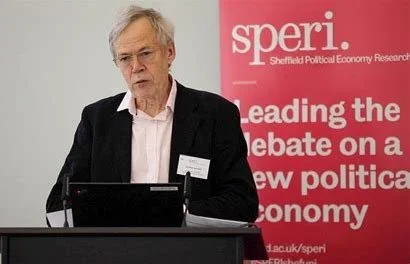
Andrew Gamble’s version
A decade earlier, in 1995, Sheffield professor of Political Science, Andrew Gamble authored an article authored an article called “The New Political Economy,” with each word capitalised, as would Besley nine years later. His article is worth quoting at length or, indeed visiting in the original (unfortunately, behind the publisher’s paywall).
On method
❝ A new political economy needs to reconstruct many of the models of economics, by subjecting their assumptions and concepts to an institutionalist and historical critique. Separating context and explanation, structure and agency, preserves the dualism which has kept economics and political science apart. The biggest single task for a new political economy is to find ways of recombining institutionalist and rational choice explanations.
On classical political economy
❝ Classical political economy was also distinctive as an approach because of its concern with policy and decision-making. It aimed not just to expIain how a particular politico-economic system worked, but how it might work and how it should work. Central to political economy has always been the appraisal of politico-economic systems and analysis of their relative advantages and disadvantages, and recommendation of the most appropriate institutions and structures for the achievement of policy goals, in particular in relation to welfare, distribution, prosperity, and growth. One of the consequences is that political economy has always been concerned with the state and with structure. It is a problem-oriented field of studying deals with values and well as an analysis of how economic, political, and social systems work. It is able to draw on different disciplines and ask fundamental questions about the way in which contemporary industrial societies are organized and how they might be improved.
During the nineteenth century political economy became an enquiry into the iron economic laws which governed human societies independent of human will, but it never lost its prescriptive, policy-oriented character. It was political economy because it was about improving government and the conduct of public policy in light of the theory about how an economy worked
The influence of Carl Menger and the Austrian school and the Methodenstreit
❝ The Austrians stressed that economic phenomena were universal rather than relative to particular historical contexts and needed to be analysed with the aid of deductive models. The Historical School argued that economic phenomena needed to be explained in relation to particular historical contexts, and therefore stressed the importance of institutions and culture.
The clash was between a method which emphasized historical uniqueness and specificity against one that emphasized abstraction and generality. These different methods became a disciplinary chasm, because economics as a discipline followed Menger and Walras abandoning historical and institutionalist approaches to the new disciplines of economic history and sociology. The result was an enormous increase in the sophistication of economics as a set of analytical techniques, reinforced by the subsequent development of econometrics, but an increasing neglect of historical and comparative studies of economic institutions. These were studied by economic historians and sociologists, often divided from economists by their methodologies, their research agendas, and increasingly by the academic organization of universities.
The lack of interest shown by economists in the tradition of classical political economy, integrating policy appraisal, normative prescription, and scientific analysis, and the failure of [Jospeh Schumpeter’s] alternative project of Sozialökonomik did not however dispense with the need either for a scientific or a normative political economy. The need became more pressing in the era of the extended state. The interrelation between politics and economics became more rather than less apparent as the scope and scale of public involvement in the economy increased, as did the need for principles to determine the new policy agendas for an increasingly interventionist state. Keynesianism developed as a policy-oriented political economy which filled this need. ❞
On ‘New Keynesianism’
❝ . . . because it constructs its argument from microfoundations, [i]t offers new ways of understanding how markets operate and how states and markets interact. It rejects key assumptions of traditional economic models, arguing instead that markets do not automatically clear, and that there can be multiple equilibria rather than a single general equilibrium, generated by spillovers, strategic complementarities, information asymmetries, and wage and price rigidities resulting from the way in which markets are organized and agents choose to act. Co-ordination problems within markets and how they are resolved become central for understanding market outcomes. From a New Keynesian perspective, asymmetries of information and power are not incidental but inherent features of markets and need to be incorporated into economic models for understanding politics. By rethinking the nature of the institutions from from an economic perspective, it offers bridges between the institutional-organizational school in economics and game theory, as well as between economic explanations of institutions and the comparative government-industrial relations literature, state theory and theories of the global political economy. It is the most exciting development in economics for a considerable time because it offers the possibility of the social sciences coming together again around a new political economy research programme rather than continuing to drift apart. ❞
His conclusion
❝ The new political economy that is currently emerging is interesting precisely because it is methodologically diverse, can make links between many disparate literatures and approaches, and is prepared to make use of both institutionalist and rational choice analysis to make sense of the profound changes in the global economy and the state system which are currently taking place. It is also comparative, policy-oriented, and not confined to the analysis of one level of the global political economy. It offers the best hope of emerging from some of the intellectual and policy straitjackets of the recent past. ❞
(Headings and emphasis added)
Besley’s version
In 2004, LSE professor, Tim Besley (now Sir Tim), authored an article titled “The New Political Economy,” based on his Keynes lecture at the British Academy of the same name. He began by decribing New Political Economy thus:
❝ a body of research and thinking that has flourished in the past fiffteen years or so at the interface between economics and politics. At the margin the New Political Economy reverses the split that occurred between the disciplines of economics and political science at the end of the nineteenth century.
❝ The aim of the New Political Economy is to understand important issues that arise in the policy sphere. It is not, as is occasionally hinted, an effort by economists to colonize political science. Rather, the main concern is to extend the competence of economists to analyze issues that require some facility with economic and political decision making. ❞
Besley’s version (with apologies to the late, great Canadian author Mordecai Richler) would effectively have political economy regain its utility — utility that has been squandered since economics rejected any reasoning not sustained and explicated by mathematical formalism of the Samuelsonian form.
Besley’s language gives him away. The use of the expression “at the margin,” unnecessary, as it is, to the meaning of the sentence that follows, suggests that his protestations of innocence of economists colonising political science ring a trifle hollow. His aim is, rightly, to return the field of economics to policy utility, but his method is, again rightly, to position economists as primary advisors on economic issues in political discourse. The problem is, the economics ‘profession’ is only willing to do so on its own terms. There has been no wholesale inculcation of the methods or manners of political science in to economic teaching or learning.

What should a renewed political economy encompass?
Gamble’s vision of a renewed political economy offers a far greater prospect of utility that Besley’s later, narrower advocacy of accommodation. Where Besley envisages an acceptance of widening of parameters of economic debate and evaluation to expand the reach of economics, Gamble’s vision proposes a beneficial synthesis of objectives, approach and method that acknowledges that different approaches are necessary to resolve any practical economic problem. Whereas Besley retains the presumed purity and superiority of inductive economic method, Gamble accepts that utility and efficacy require trading off some of that methodological purity for the triangulating perspectives that the wider methodology set of which he writes is capable.
In that sense, Gamble echoes the methodological call of the great American political scientist James Q. Wilson, who stated:
❝ Whenever we try to discover a relationship between hard-to-measure factors that operate deep inside a complex social structure, we are well advised not to rely on any single method of analysis, and we are particularly well advised not to rely on statistical studies using aggregate data. We should attack the problem from a number of angles, using different kinds of data and various methodologies. Above all, we should look at what happens to individuals (rather than to cities or states) and at what happens when a new program is tried. ❞
(“Thinking About Crime: The debate over deterrence,” The Atlantic, September 1983)
Policy debate consists of two fundamentally different types of issues:
The first is principles upon which policy should be predicated. These are unavoidably ideological and necessitate accepting value judgments and, preferably, explicit conceptions of social justice.
The second is the structure of the policy and the details as they apply to people on whom the policy will act and, in subsequent consequential effects, who will be impacted by the policy. It is in this second form that Wilson’s call for multiple approaches to analysis of any problem is so crucial.
By allowing differing capabilities, capacities and reactions by differing economic agents, anticipation of varying consequential effects of prospective policy prescriptions will enhance understaanding of their real impact. This form of analysis focuses at the agent level and directs attention to agent-based stochastic modelling.
By rejecting the validity of addressing issues of the first type, and by the imposition of strictures on the methods deployed in the second type, economics has rendered itself sterile and ineffective as a tool to support “the science of the legislator or statesman;” that is, practical policy analysis and decision-making. The answer is a far broader economics curriculum that addresses the issues of foundational principles and accepts the relevance of the political, social, moral and institutional structures within which any policy that is adopted will operate. Anything less is simply economic sophistry.